Hand It Over in Writing: The Five-Line Brief Your Garage Actually Wants
Photo: Stephen McKay, CC BY-SA 2.0, via Wikimedia Commons
You know the scene. You are at the counter, keys in hand, and the person behind the screen asks what is wrong. You say it is making a funny noise. They nod, write 'noise' on a job card, and off the car goes. Three hours later the phone rings because the technician cannot reproduce it, and you are trying to describe a sound down the phone to someone standing next to a running engine.
That is not a garage being difficult. It is an information gap, and most of it can be closed with a note shorter than a shopping list.
Why a scrappy written note beats a chat
A busy workshop is not a quiet place. Reception might take in a dozen cars before lunch, and the verbal story you told at the desk has a habit of staying at the desk. A written note travels with the job card, gets clipped to the file, and ends up in front of the person with the spanners. Technicians read. They also compare notes with each other, and a clear written complaint means the second pair of eyes starts in the right place.
A note is not a diagnosis. It is evidence. You are not telling them what is broken; you are telling them what the car is doing. That distinction matters, and it keeps both sides honest.
The five lines worth writing
Line 1: When and where it happens
Speed, gear, steering, braking, temperature, road surface. 'Only when turning left at low speed, like into a car park' is worth ten minutes of guessing. 'Only from cold, gone after ten minutes' is just as useful. If it happens on the motorway at 70mph, say so, and say whether it is constant or comes and goes.
Line 2: What it sounds or feels like
Comparisons work better than adjectives. A whistling kettle, a dry door hinge, a coin rattling in a tin, a grinding scrape, a single clunk, a vibration through the wheel or the seat or the brake pedal. Note whether it changes with engine revs or road speed — that alone can point a technician towards the engine bay or the running gear. If you can safely record it, do. A passenger holding a phone is fine; you holding one while driving is not.
Line 3: Which warning lights, and when
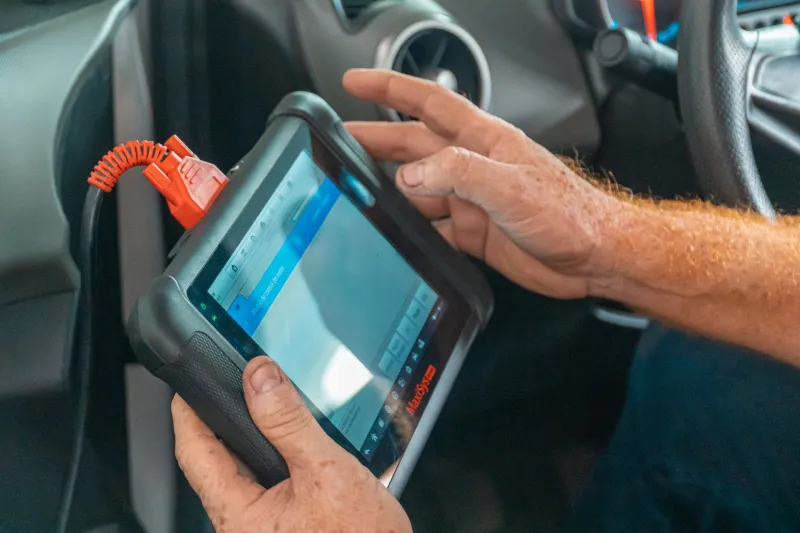
Take a photo of the dashboard. Say whether the light is solid or flashing, when it appeared, and whether it cleared on its own. Do not plug in a cheap code reader and wipe the fault memory before you arrive. That is destroying evidence, even if it feels like tidying up.
Line 4: Recent history
Anything done in the last few months, even if it seems unrelated — tyres, brakes, battery, a windscreen chip, a service at another garage. Recent knocks count too: a kerb, a deep pothole, a speed bump taken too quickly. So do recent fill-ups if the problem started around the same time. If you have already had a go with a DIY reader, own up. Half a story is worse than none.
Line 5: Contact, budget and permissions
Best number, best times, and whether you would rather be texted. Then the bit most drivers forget: what you are authorising. A rough ceiling for diagnostic work, whether you want a call before anything beyond that, whether the car can stay overnight, and whether they are welcome to take it on a test drive. Say it up front and the mid-service phone call becomes a conversation rather than an ambush.
What that looks like in practice
Vauxhall Corsa, 2019, 63,000 miles.
Rattle from the front near side, only over speed bumps and rough tarmac at 20-30mph. Not there on smooth roads.
Sounds like something loose in a plastic box. Felt slightly through the steering wheel once.
No warning lights on the dash.
Front tyres replaced six weeks ago. Hit a deep pothole on the A34 about a month back.
Call Sam before 9am or after 5pm. Happy to authorise up to £150 for diagnosis and obvious fixes; please call before anything more. No rush, can stay overnight. Test drives fine.
That gives a technician a running start. Recent tyre work plus a pothole points the mind towards a drop link, an anti-roll bar bush, wheel balance or a damaged suspension component. Even if the first guess is wrong, they know where to look and where not to waste time.
What to leave off the note
Do not diagnose. 'It needs new brake discs' is a conclusion; 'grinding from the rear when braking gently' is a symptom, and it is far more useful. Do not write a page of backstory about the car's entire life. Do not use the note to haggle — that is a separate conversation, and mixing the two makes the job card awkward. And keep it legible. If your handwriting is a mystery to you, type it into your phone and print it, or ask reception to add it to the job card while you are standing there.
Why this cuts the vague phone call
The dreaded mid-service call usually happens for one of two reasons: the technician has found something unexpected, or they cannot pin down the original complaint. A clear brief reduces the second, and a clear budget line reduces the sting of the first. It also makes extra work easier to judge, because you have already decided what you are willing to authorise before anyone is standing under the car with a torch.
A template to keep in the glovebox
Five lines, under a hundred words, written before you leave the house. Hand a copy over with the keys and keep one for yourself. If a warning light is on, add a photo of the dash. If you have a recording of the noise, mention it and offer to send it — do not rely on playing it in a noisy reception area.
The best garages ask good questions. Give them good answers in writing and you will both save a day of guesswork. That is the whole trick.